
 0 Comments

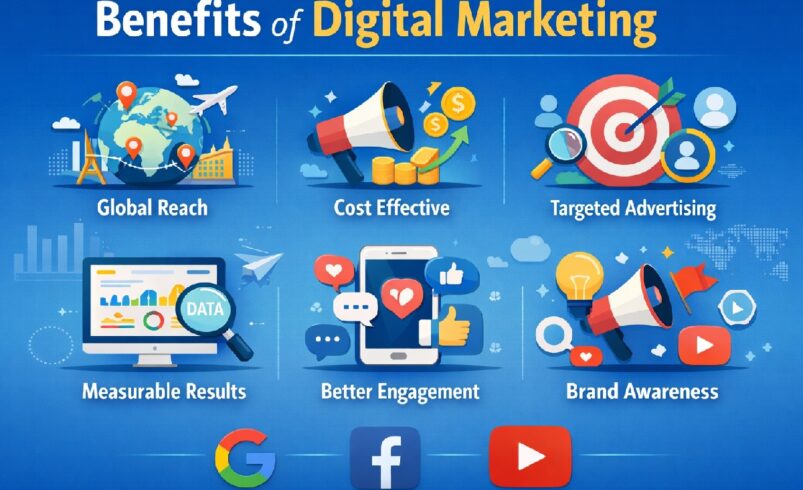
Benefits of digital marketing refer to the advantages businesses gain by promoting their products and services on online platforms and through digital technologies. These benefits include wider audience reach, cost-effective advertising, targeted marketing, measurable results, improved customer engagement, and greater brand visibility. Using digital channels like Google, Facebook, and YouTube, businesses can connect with potential patrons globally, track crusade performance, and achieve higher returns on investment than with
What is Digital Marketing?
Digital marketing is the promotion of products and services using the internet and digital technologies. It involves online channels such as websites, search engines, social media, email, and mobile apps to reach customers. Businesses use platforms like Google, Instagram, and YouTube to advertise and connect with their target audience.
It helps companies reach people globally, engage customers in real time, and promote their brands profitably. Digital marketing also allows businesses to track performance and data through analytics. It is extensively used for brand awareness, lead generation, and increasing online sales.
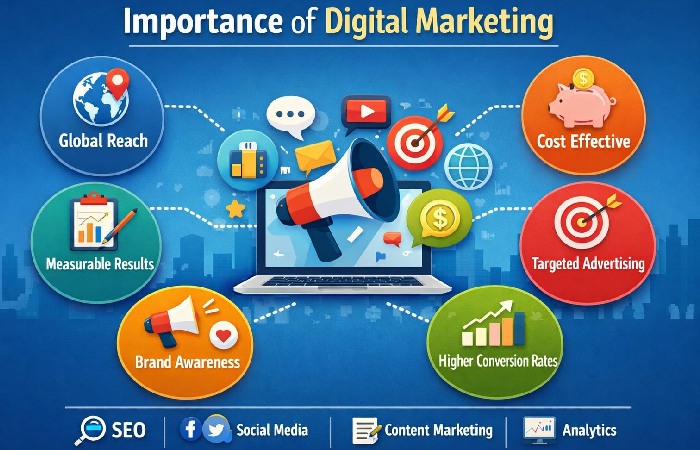
The Importance of Digital Marketing
| Aspect | Importance |
| Global Reach | Helps businesses reach customers universally through the internet without needing physical branches. |
| Cost-Effective | More sensible than traditional advertising like TV, newspapers, and radio. |
| Targeted Marketing | Allows businesses to target specific audiences based on age, location, interests, and behavior. |
| Measurable Results | Tools like Google Analytics help track performance, traffic, and conversions in real time. |
| Brand Awareness | Digital platforms surge brand visibility over social media, websites, and search engines. |
| Customer Engagement | Businesses can directly interact with customers via platforms like Instagram and Facebook. |
| Higher Conversion Rates | Beleaguered campaigns convert more viewers into customers, just as traditional marketing does. |
| 24/7 Marketing | Online raises run all day, subject only to time or location limitations. |
| Personalization | Businesses can provide customized content and product recommendations based on customer preferences. |
| Mobile Access | Enables marketing through smartphones, apps, SMS, and mobile-friendly websites. |
| Competitive Advantage | Helps trades contest with larger brands using smart digital strategies. |
| Multiple Channels | Includes SEO, email marketing, social media marketing, content advertising, and paid ads. |
| Real-Time Customer Feedback | Reviews, ratings, and comments help businesses quickly improve products and services. |
| Automation | Email campaigns, chatbots, and arranged posts save time and improve competence. |
| Better ROI | Lower asset with higher returns, likened to traditional marketing methods. |
How to Create a Digital Marketing Strategy?
Creating a digital marketing strategy is essential for businesses that want to grow online, attract the right audience, and achieve their marketing goals professionally. A well-planned plan acts as a roadmap for leaders to guide all digital activities, ensuring efforts are focused, consistent, and measurable.
Set Clear Goals and Objectives
Define what you want to achieve, such as increasing website traffic, generating leads, improving brand consciousness, or boosting sales. Clear goals help measure success.
Identify Your Target Audience
Understand your ideal customers by analyzing their age, gender, location, interests, online behavior, and purchasing patterns. This helps create modified campaigns.
Conduct Market Research
Study contestants, industry trends, and customer preferences. Research helps identify market opportunities and gaps.
Choose the Right Digital Marketing Channels
Select stages where your audience spends most of their time, such as search engines like Google, social media platforms like Instagram and LinkedIn, email marketing, or content platforms.
Create High-Quality Content
Content is the core of digital marketing. Develop compelling blogs, videos, infographics, social media posts, and emails that add value to your audience.
Optimize for Search Engines (SEO)
Improve website visibility in search results through keyword research, high-quality content, backlinks, and technical optimization.
Plan Your Budget
Allocate funds wisely across channels such as paid ads, content creation, influencer marketing, and automation tools.
Implement Marketing Automation Tools
Use tools to automate emails, social media posts, and customer interactions to save time and maintain consistency.
Monitor and Measure Performance
Track movement presentation using analytics tools to measure traffic, appointments, leads, and conversions.
Analyze and Optimize
Regularly review results and recovery plans, adjusting content, ads, and targeting methods to improve performance.
Focus on Customer Engagement
Interact with customers through comments, messages, reviews, and personalized messages to build trust and loyalty.
Update Strategy Regularly
Digital trends change quickly, so businesses must adapt their strategies to stay relevant and up to date.
What Are the Different Types of Digital Marketing?
| Type | Description | Common Platforms / Tools |
| Search Engine Optimization (SEO) | Recovers website ranking on search engines to increase organic (free) traffic. | Google Search, Bing |
| Pay-Per-Click Advertising (PPC) | Businesses pay only when users click on their online ads. | Google Ads, Microsoft Raise |
| Social Media Marketing | Indorsing brands and attractive audiences on social media platforms. | Facebook, Instagram, LinkedIn, X |
| Content Marketing | Making valuable content to attract and retain customers. | Blogs, YouTube, Infographics |
| Email Marketing | Sending promotional messages and newsletters straight to purchasers’ inboxes. | Mailchimp, ConvertKit |
| Affiliate Marketing | Making a command by promoting other companies’ products or services. | Amazon Associates, ShareASale |
| Influencer Marketing | Collaborating with influencers to promote products to their followers. | Instagram Creators, YouTube Influencers |
| Video Marketing | Using videos to promote products, services, or brand consciousness. | YouTube, TikTok, Vimeo |
| Mobile Marketing | Reaching spectators through mobile devices via apps, SMS, and mobile ads. | Mobile Apps, SMS Campaigns, Google AdMob |
| Online Public Relations (PR) | Handling brand standing through online media attention and digital publications. | PR Newswire, Online News Portals |
| Marketing Automation | Using software to automate marketing tasks and customer selection. | HubSpot, Marketo |
| Native Advertising | Paid ads that match the look and feel of the phase where they appear. | Taboola, Outbrain |
Top 10 Benefits of Digital Marketing
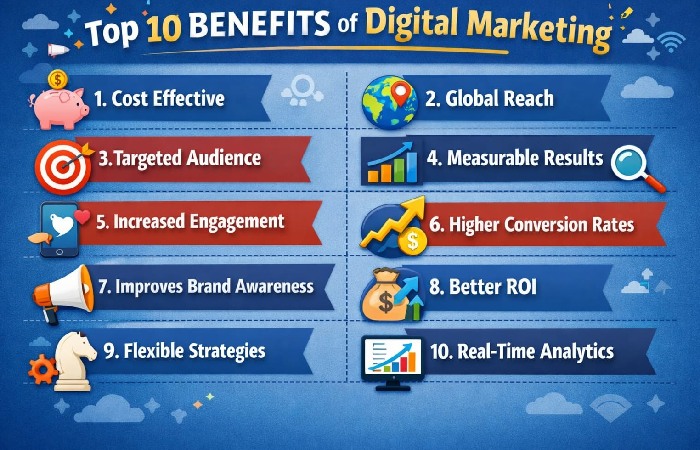
Digital marketing has transformed how businesses connect with customers in the modern world. With the rapid growth of the internet, smartphones, and social media platforms, companies now have powerful tools to reach their target spectators quickly and efficiently. Unlike traditional marketing approaches such as newspapers, television, and billboards, digital marketing enables businesses to promote their products and services online with greater precision, measurable results, and lower costs.
1. Global Reach and Wider Audience Engagement
One of the biggest advantages of digital marketing is its ability to reach a global audience. With the help of the internet, businesses can promote their products to customers across different countries and time zones without needing a physical presence. Even a small local company can sell globally through e-commerce platforms and digital advertising.
2. Cost-Effective Marketing with High ROI
Digital marketing is much more cost-effective than traditional publicity methods. Running ads in newspapers, on television, or on the radio can be very expensive and often does not guarantee results. In contrast, digital marketing campaigns can be modified based on budget, making them ideal for small and medium-sized businesses.
3. Targeted Audience Reach
Traditional marketing methods often target a broad audience, including people who are not deeply engaged with the product. Digital marketing solves this problem by allowing businesses to target specific audiences based on age, gender, location, interests, online behavior, and buying habits.
4. Measurable Results and Analytics
Another major benefit of digital marketing is the ability to accurately measure results. Businesses can track the performance of their movements in real time and examine what works best.
5. Higher Conversion Rates
Digital marketing helps businesses achieve higher conversion rates than traditional marketing. Since campaigns are targeted to interested audiences, the likelihood of converting viewers into customers increases significantly.
6. Improved Customer Engagement
Digital marketing allows direct communication between brands and customers. Through social media platforms, email newsletters, chatbots, and websites, businesses can interact with customers instantly.
7. Brand Awareness and Reputation Building
A strong online presence is essential for establishing brand awareness in today’s competitive market. Digital advertising helps brands stay visible across multiple channels, including search engines, social media, blogs, and websites.
8. Mobile Marketing Advantage
With the increasing use of smartphones, digital marketing enables businesses to reach customers directly on their mobile devices. Mobile-friendly websites, apps, SMS marketing, and social media promotions ensure constant visibility.
9. Flexibility and Customization
Digital marketing campaigns can be easily modified based on performance. Businesses can change ad copies, images, budgets, audience targeting, and strategies in real time.
10. Faster Results
Digital marketing delivers faster results than traditional marketing methods. While SEO may take time, strategies like PPC advertising and social media promotions generate immediate traffic.
The Future of Digital Marketing: Top Trends for 2026
| Trend | Why It Matters in 2026 |
| AI-Driven Marketing Automation | Artificial intelligence will automate ad campaigns, optimise targeting, and personalise content, making marketing more well-organized and data-driven. |
| Hyper-Personalisation | Brands will use AI and customer data to deliver highly personalised messages and product suggestions, improving meetings and conversions. |
| Voice & Conversational Search Optimization | With the rise of voice assistants, SEO strategies will shift to natural language queries and informal content. |
| Short-Form Video Dominance | Bite-sized videos will remain a leading content format for engagement and brand discernibility on platforms like YouTube, Instagram, and TikTok. |
| Social Commerce Growth | Social media will increasingly function as a direct shopping channel, blending content with seamless purchase experiences. |
| Privacy-First & First-Party Data Strategies | With the decline of third-party cookies, brands will rely on first-party data to build trust and personalise effectively. |
| Immersive AR/VR Experiences | Augmented and virtual reality will create interactive, engaging customer knowledge, especially in e-commerce and product try-ons. |
| Creator & Community Collaboration | Deeper meetings with micro-influencers and community-driven content will strengthen loyalty and authenticity. |
Advantages and Disadvantages of Digital Marketing
Digital marketing has become a powerful way for businesses to promote their products and services. It allows brands to reach large audiences, engage with customers directly, and measure campaign results in real time. Compared to traditional marketing, digital methods are more flexible, cost-effective, and extremely targeted.
| # | Advantages | Disadvantages |
| 1 | Global reach allows businesses to entice customers worldwide through the internet. | intense rivalry as many businesses promote similar products online. |
| 2 | Cost-effective, comparable to traditional advertising such as TV and newspapers. | Needs continuous investment for ads, tools, and skilled professionals. |
| 3 | Beleaguered advertising helps reach specific audiences based on demographics and interests. | Privacy concerns due to data collection and user behavior tracking. |
| 4 | Measurable results using analytics tools like Google Analytics. | Analytics can be complex and require know-how to interpret correctly. |
| 5 | Faster communication between brands and customers through social media. | Negative feedback and reviews can spread quickly online. |
| 6 | Higher appointment through interactive content like videos and social posts. | Continuous content creation is time-consuming and resource-intensive. |
| 7 | Easy to modify campaigns and strategies in real time. | Heavy dependence on technology and internet connectivity. |
| 8 | Manifold marketing channels such as SEO, email, and social media. | Handling many channels can be complicated without proper planning. |
| 9 | Better return on investment (ROI) due to presentation tracking and optimization. | Ad fatigue may occur when users repeatedly see the same advertisements. |
| 10 | Personalization improves customer knowledge and satisfaction. | Digital marketing skills require practice and even updates to keep up with trends. |
Why These Benefits Work for Brands of Any Size
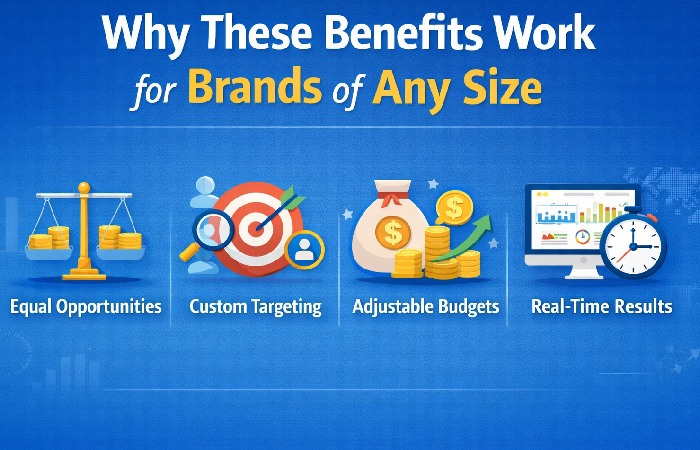
Digital marketing benefits businesses of every size because it offers flexible budgeting, precise audience targeting, and measurable performance tracking. Whether it is a small startup or a large enterprise, digital platforms enable brands to compete fairly, reach customers directly, and adjust plans based on real-time data.
Cost Flexibility
- Businesses can start with small budgets and scale campaigns as they grow.
• Affordable tools and ad platforms make marketing accessible to startups and local brands.
Targeted Reach
- Advanced targeting safeguards promotions reach people genuinely interested in the product or service.
• Platforms like Facebook and Google Ads allow demographic and interest-based targeting.
Measurable Performance
- Real-time analytics help brands track campaign success and customer behavior.
• Insights from Google Analytics allow data-driven decision-making.
Scalable Strategies
- Campaigns can be prolonged easily when business demand increases.
• Marketing plans can grow from local movements to global promotions.
Better Customer Engagement
- Direct communication builds trust and long-term relationships with customers.
• Social media platforms enable prompt interaction, feedback, and brand loyalty.
Level Playing Field
- Small businesses can compete with large brands using creative content and smart strategies.
• Strong online attendance reduces the benefit of large publicity budgets.
Multi-Channel Presence
- Brands can promote products across search engines, social media, email, and websites.
• Multiple channels increase visibility and customer touchpoints.
Quick Adaptability
- Campaigns can be modified instantly based on trends and performance.
• Makes can quickly respond to customer wants and market vicissitudes
Conclusion
Digital marketing has become a vital tool for modern businesses seeking growth, visibility, and client engagement. Its ability to reach global audiences, provide quantifiable results, reduce costs, and deliver personalized experiences makes it more real than traditional marketing methods. From inaugurations to large enterprises, each business can benefit from digital strategies to improve brand awareness, increase sales, and build lasting customer relationships.