


 0 Comments

Introduction to digital marketing has become a necessity for successful business development nowadays. Various types of businesses use the Internet for finding their potential customers, raising awareness about their brands, generating leads, and boosting sales.
For all those who wish to learn about digital marketing, wisestudyspot.com offers some introductory information about digital marketing strategies that could help them start their search on search engines, social media, content, emails, and other forms of paid advertisements.
What Is Digital Marketing?
Digital marketing is understood as the promotion of products, services, brands, or businesses through various digital channels.
These channels include:
- Search engines
- Websites
- Social media
- Online advertising
- Video platforms
- Mobile applications
- Content platforms
In contrast to traditional marketing, digital marketing allows tracking of interactions, traffic, leads, and conversions for businesses.
Search Engine Optimization
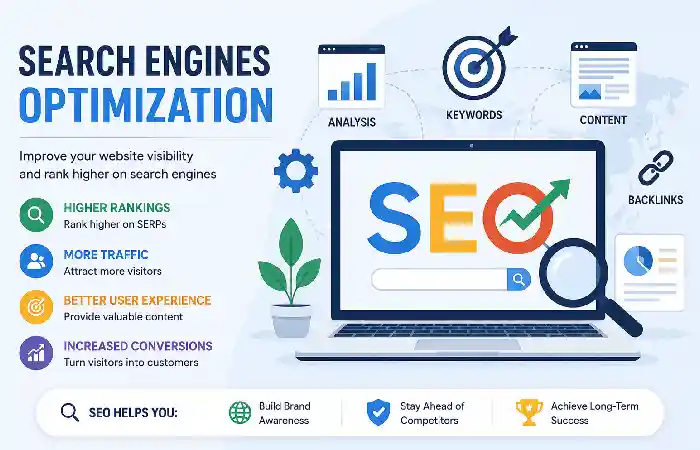
One of the key strategies of digital marketing is the so-called search engine optimization (SEO).
SEO implies increasing the visibility of websites in organic search results.
Activities that may be included in the SEO process are:
Keyword Research
This means businesses try to find out search terms that are used by their potential customers when they are searching for certain products or services.
On-page SEO
Optimization of:
- Page titles
- Headings
- Meta descriptions
- Content
- URLs
- Internal links
- Images
Technical SEO
This process may involve such aspects of SEO as optimization of website speed, mobile usability, indexing, structured data, and site architecture.
Link Building
High-quality backlinks from relevant sites increase the credibility of websites, even if they meet the requirements of search engines.
Content Marketing
Content marketing includes creating informative and valuable content aimed at a certain target audience.
Types of content may vary and include:
- Blog posts
- Guides
- Tutorials
- Videos
- Infographics
- Case studies
- Ebooks
- Social media posts
Good content not only answers users’ questions but also provides them with useful information rather than keyword repetition.
Social Media Marketing
Social media gives businesses direct communication channels with their audiences.
Main social media platforms include:
- YouTube
- TikTok
Social media strategy can include such steps as publishing educational posts, promoting products, customer interaction, posting videos, and monitoring audiences’ engagement.
Email Marketing
Although there are many other ways for communication with customers, emails remain helpful tools for contacting existing clients and leads.
Using email marketing, businesses can:
- Send newsletters
- Announce products
- Conduct promotions
- Provide educational content
- Send welcome emails
- Retain customers
- Announce events
Key factors of successful email marketing are permission-based email lists, valuable content, correct segmentation, and calls-to-action.
Pay-Per-Click Advertising
Pay-per-click advertising allows businesses to pay for targeted online advertising rather than relying entirely on organic traffic.
Search advertising can place a business in front of people actively searching for relevant products or services.
Important PPC metrics include:
| Metric | Meaning |
| Impressions | Number of times an ad is shown. |
| Clicks | Number of ad interactions |
| CTR | Percentage of impressions generating clicks. |
| CPC | Cost per click |
| Conversions | Desired actions completed |
| CPA | Cost per acquisition |
| ROAS | Revenue compared with advertising spend |
Monitoring such metrics will help to learn whether marketing campaigns yield valuable results.
Local Digital Marketing
Local enterprises may take advantage of digital marketing to reach customers residing in certain geographical areas.
Effective tactics are:
- Local SEO
- Business listings
- Location-based advertising
- Customer reviews
- Local content
- Social media marketing
A local business needs to have correct business information.
Digital Marketing for Small Enterprises
Small enterprises do not necessarily require a big marketing budget to create their online presence.
At least a basic approach could consist of:
- Professional website.
- Keyword research.
- Valuable blog content.
- Local SEO if needed.
- At least one or two social media networks.
- Email collection in an appropriate way.
- Analytics and conversion tracking.
Small businesses will be able to expand their marketing efforts when they figure out which ones generate good results.
Mobile Marketing
Quite a lot of internet usage takes place via smartphones.
Therefore, it is necessary to make sure that websites and campaigns function well in a mobile environment.
Important factors are:
- Responsive design
- Loading speed
- Easy navigation
- Readable text
- Mobile-friendly forms
- Easy checkout process
Poor mobile experience may lead people to quit before performing the intended actions.
Video Marketing
Video marketing is a fast way to get information and is especially good at showcasing products and services.
Videos may be used for:
- Tutorials
- Demonstrations of products and services
- Testimonials
- Education
- Brand story
- Short videos for social media
- Advertisements
The most effective video format depends on the target audience and platforms.
Analytics and Measurement
Measuring performance makes digital marketing more effective.
Key metrics may be:
- Organic traffic
- Social media engagement
- Leads
- Conversions
- Customer acquisition costs
- Revenue
- ROI
Building a Digital Marketing Strategy
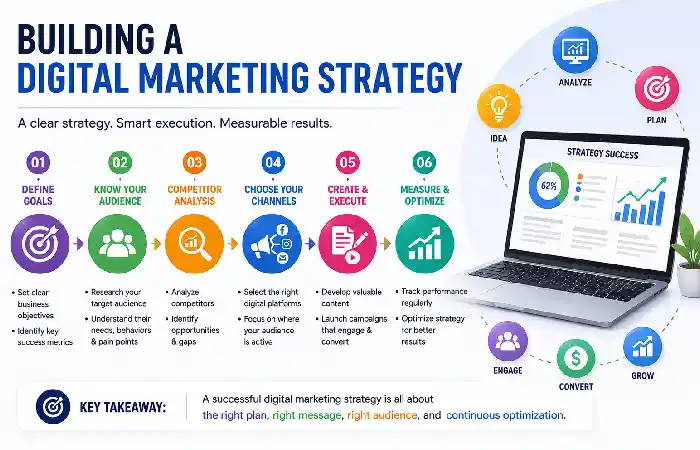
First of all, one should understand who their target audience is.
Step 1: Identify Your Target Audience
Figure out who your company addresses.
↓
Step 2: Determine Your Objectives
Objectives may include traffic generation, lead generation, sales, and branding.
↓
Step 3: Conduct a Competitor Analysis
Analyze the content, keywords, advertisements, and positioning of the competitor’s customers.
↓
Step 4: Choose Relevant Channels
Choose those channels that are most relevant to the target audience.
↓
Step 5: Create Valuable Content
Create valuable content that would solve the problem of your customers.
↓
Step 6: Analysis of Results
Understand what kind of activities bring results through analysis of statistics.
↓
Step 7: Continue Working
Digital marketing presupposes constant optimization.
Common Mistakes of Digital Marketing
One may be unable to achieve one’s objectives because of mistakes in the working process.
Thus, businesses make the following mistakes:
- Use very general keywords
- Create poor quality content
- Neglect mobile users
- Benefit only from traffic
- Fail to track conversions
- Receive poor quality links
- Insufficient distribution of content
- Work with numerous marketing channels at once
- Fail to attend to customers’ feedbacks
A strategy aimed at a particular field becomes more measurable and convenient.
The Future of Digital Marketing
In the future of digital marketing, such aspects as automation, artificial intelligence, personalization, videos, and data-driven marketing play an important role.
Thus, artificial intelligence will allow doing the following things:
- Create ideas for content
- Analyze the information
- Segment customers
- Optimize campaigns
- Marketing automation
- Marketing research.
It is necessary to analyze the AI-generated content to make sure it is accurate and consistent with the brand.
Frequently Asked Questions
What is Digital Marketing?
The promotion of any products, services, brands, or business via online and digital platforms, including search engines, websites, social media, email, and online ads.
Why is SEO important?
SEO may assist websites in obtaining organic search traffic, which will not be paid per click.
Is digital marketing appropriate for small businesses?
Yes. SEO, content marketing, social media, email, and local marketing may be implemented by small businesses in order to attract potential clients within their resources.
How long does digital marketing take to yield results?
Results will differ depending on applied strategies. For example, traffic from paid advertising may appear immediately, whereas SEO and content marketing may take longer to produce some results.
What is the most effective digital marketing strategy?
There is no universal digital marketing strategy that is suitable for all companies. Every company should develop its own strategy considering many factors such as target audience, industry, competition, objectives, budget, and resources.
Conclusion
Search results of digital marketing wisestudyspot.com are helpful for readers who want to learn about online marketing techniques and methods used by companies in order to obtain visibility online.
SEO, content marketing, social media, email, PPC, video, and analytics are among many strategies that are used by businesses in order to communicate with potential customers. The main thing is to select strategies according to business goals, to create useful content, analyze results, and constantly improve marketing campaigns. A successful digital marketing strategy is not about receiving more website visits but about attracting the right audience and converting visitors into clients.