


 0 Comments

The Digital Differential Analyzer (DDA) algorithm is one of the initial and most fundamental line-drawing procedures in computer graphics. It plays a crucial role in rendering conventional lines on raster displays, where images are composed of pixels. Despite being an older method, understanding DDA provides valuable insights into how processors convert mathematical line drawings into visual images.
What is the DDA Algorithm?
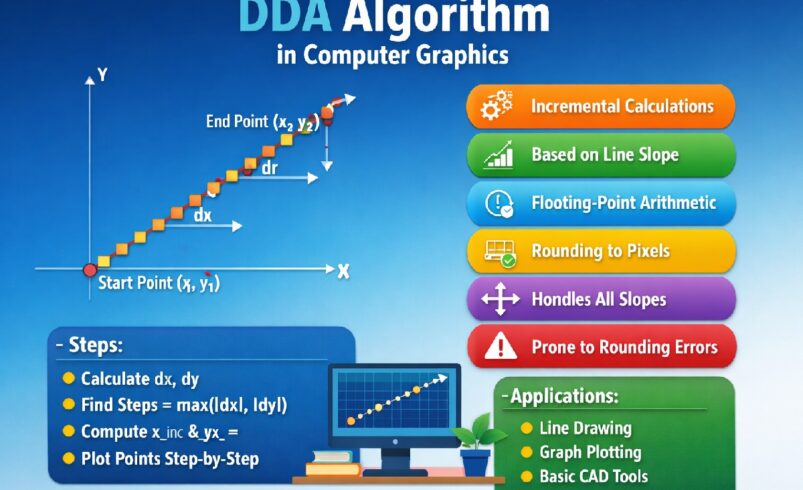
The DDA algorithm is a scan-conversion method for drawing a straight line between two assumed points in a coordinate system. It works by calculating the middle points between the start and end points, then organizing and iterating them one at a time.
Unlike modern optimized algorithms, DDA relies on floating-point arithmetic, which makes it conceptually simple but slightly less efficient. However, its ease makes it ideal for learning the basics of computer visuals.
Example of DDA Algorithm in Computer Graphics
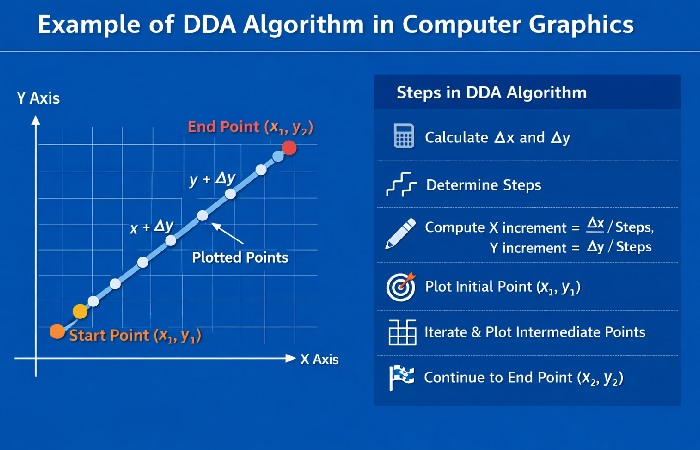
Here is a DDA Algorithm example in table form, presentation step-by-step control:
DDA Algorithm Example
Let’s draw a line from point (2, 3) to (10, 7)
Stages = max(8, 4) = 8
Step-by-Step Table
| Step | x (before round) | y (before round) | x (round) | y (round) |
| 0 | 2.0 | 3.0 | 2 | 3 |
| 1 | 3.0 | 3.5 | 3 | 4 |
| 2 | 4.0 | 4.0 | 4 | 4 |
| 3 | 5.0 | 4.5 | 5 | 5 |
| 4 | 6.0 | 5.0 | 6 | 5 |
| 5 | 7.0 | 5.5 | 7 | 6 |
| 6 | 8.0 | 6.0 | 8 | 6 |
| 7 | 9.0 | 6.5 | 9 | 7 |
| 8 | 10.0 | 7.0 | 10 | 7 |
Uses of the DDA Algorithm in Computer Graphics
| Use Case | Description |
| Line Drawing | Used to draw straight lines between two points on raster displays |
| Graphics Education | Helps students understand basic concepts of computer graphics |
| Interpolation | Calculates intermediate values between two points |
| Simple Drawing Applications | Used in basic paint and drawing software |
| Graph Plotting | Helps in plotting linear graphs and charts |
| Animation | Assists in generating smooth motion paths |
| CAD Systems (Basic) | Used in simple Computer-Aided Design tools |
| Rasterization | Converts mathematical line equations into pixel representation |
| Game Development (Early Systems) | Used in old video games for rendering lines |
| Simulation Tools | Helps in modeling linear movements and paths |
| Debugging Graphics Systems | Used for testing and verifying rendering processes |
| Embedded Systems Graphics | Applied in low-level graphics where simplicity is preferred |
| Scan Conversion | Converts geometric data into screen pixels |
| Prototype Development | Useful for the quick implementation of graphics features |
Working Principle of DDA Algorithm
The core idea behind the DDA algorithm is to divide the line into equal steps and compute the coordinates of each step using the line’s slope.
Given two points:
The algorithm calculates:
Then, the number of steps is determined as:
- Steps = max(|dx|, |dy|)
Each step increments the x and y values as:
The algorithm starts from the initial point and adds increments to generate the next pixel positions.
Steps of DDA Algorithm
Calculate dx and dy
Determine the number of steps
Compute x and y increments
Start plotting from the initial point
Increment x and y values and plot points
Basics of the DDA Algorithm
| Concept | Description |
| Full Form | Digital Differential Analyzer |
| Purpose | To draw a straight line between two points on a screen |
| Input | Starting point (x₁, y₁) and ending point (x₂, y₂) |
| Output | Set of plotted pixel coordinates forming a line |
| Key Idea | Incrementally calculate intermediate points using the slope. |
| dx | Difference in x = x₂ − x₁ |
| dy | Difference in y = y₂ − y₁ |
| Steps | Maximum of |
| x Increment | dx / Steps |
| y Increment | dy / Steps |
| Calculation Type | Floating-point arithmetic |
| Iteration Process | Add increments to x and y for each step. |
| Rounding | Coordinates are rounded to the nearest pixel value. |
| Line Slope Handling | Works for all slopes (positive, negative, steep, shallow) |
| Efficiency | Moderate (slower than integer-based algorithms) |
| Accuracy | May have rounding errors |
| Ease of Implementation | Very easy and beginner-friendly |
| Main Use | Basic computer graphics for educational purposes |
Advantages and Limitations of the DDA Algorithm
While DDA is simple and intuitive, it has both strengths and weaknesses.
Advantages
Easy to implement
Suitable for basic graphics applications
Handles all types of line slopes
Conceptually straightforward
Limitations
Uses floating-point operations (slower than integer methods)
Rounding errors may occur
Less efficient compared to advanced algorithms
Accumulated errors can distort the line
Comparison of DDA with Other Line Drawing Algorithms
To better understand DDA, it is useful to compare it with other popular algorithms, such as Bresenham’s Line Algorithm.
| Feature | DDA Algorithm | Bresenham Algorithm |
| Calculation Type | Floating-point | Integer-based |
| Speed | Slower | Faster |
| Accuracy | Less accurate (rounding errors) | More accurate |
| Complexity | Simple | Moderate |
| Performance | Lower | Higher |
| Hardware Efficiency | Less efficient | More efficient |
| Implementation Difficulty | Easy | Slightly complex |
Applications of the DDA Algorithm in Computer Graphics
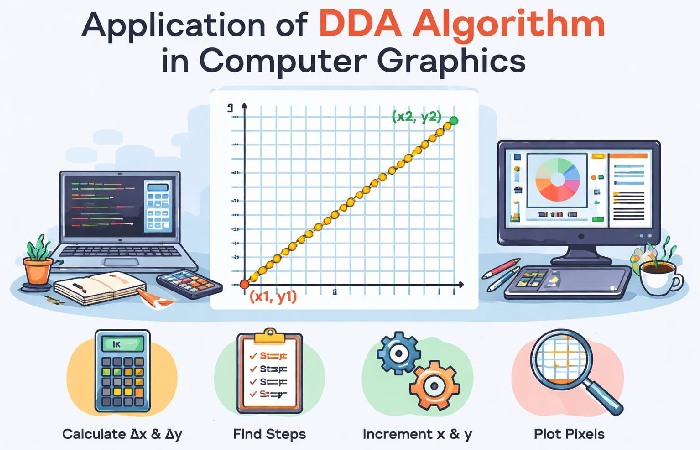
Although newer algorithms are preferred today, DDA still has important applications, especially in educational and basic graphics systems.
Common Applications
Drawing lines in simple graphics programs
Teaching computer graphics concepts
Interpolation in animation
Plotting graphs and charts
Basic CAD (Computer-Aided Design) tools
Real-World Usage
Early video games
Raster graphics systems
Simulation tools
Educational software.
DDA Algorithm in Computer Graphics (C Program)
The DDA algorithm in C draws a straight line by calculating intermediate points between two coordinates using small incremental steps. It is simple to implement and mainly used for educational purposes in computer graphics.
| Step | Description |
| Input Organizes | Define starting (x₁, y₁) and ending (x₂, y₂) points |
| Calculate dx, dy | Find differences between x and y values. |
| Determine Steps | Steps = max( |
| Compute Increases | x_inc = dx/steps, y_inc = dy/steps |
| Initialize Values | Start from the initial point (x₁, y₁) |
| Loop Through Steps | Increment x and y values in each iteration |
| Round Values | Convert floating values to the nearest integer for pixel plotting. |
| Output Points | Print or plot the calculated pixel coordinates. |
Key Components of the DDA Algorithm
The Digital Differential Analyzer (DDA) algorithm relies on a few essential mechanisms that work together to make a straight line between two points on a pixel-based display. Sympathetic, these mechanisms help in grasping how the procedure makes step-by-step interpolation.
Input Coordinates
The algorithm begins with two points: (x₁, y₁) and (x₂, y₂)
These define the line’s starting and ending positions.
Difference Values (dx, dy)
→ change in x-direction
→ change in y-direction
These values control the slope and the line’s direction.
Number of Steps
Steps = max(|dx|, |dy|)
This ensures smooth plotting regardless of line steepness.
Increment Values
These increments control how much x and y change at each step.
Initial Point
The algorithm starts plotting from the initial coordinate (x₁, y₁)
This acts as the base for further calculations.
Iterative Calculation
At each step:
x = x + x_inc
y = y + y_inc
This process continues until the final point is reached.
Rounding Function
Since pixel values must be integers, the calculated x and y values are rounded.
Ensures proper placement on the screen grid.
Output (Plotted Points)
The final result is a sequence of pixel coordinates
These opinions collectively form a traditional line.
Advantages and Disadvantages of the DDA Algorithm in Computer Graphics
| Aspect | Advantages | Disadvantages |
| Implementation | Very easy to understand and implement | Not optimized for high-performance systems |
| Calculation | Simple mathematical calculations | Usages of floating-point arithmetic (slower) |
| Line Handling | Works for all types of slopes (positive, negative, steep, shallow) | Requires rounding for pixel values |
| Accuracy | Produces acceptable results for basic graphics | Accumulation of rounding errors can reduce accuracy |
| Flexibility | Can be used for interpolation and basic graphics tasks | Less flexible compared to advanced algorithms like Bradenham |
| Learning | Ideal for beginners and educational purposes | Not suitable for professional or real-time graphics |
| Hardware Usage | Does not require complex hardware | Inefficient use of hardware compared to integer-based methods |
| Performance | Reasonable for simple applications | Slower execution due to floating-point operations |
| Output Quality | Generates smooth lines in many cases | May produce uneven or slightly jagged lines |
| Practical Usage | Useful for simple drawing and teaching tools | Rarely used in modern graphics systems |
DDA Algorithm in Computer Graphics in Other Countries
The DDA (Digital Differential Analyzer) algorithm is widely taught and used across many countries as a foundational concept in computer graphics. While modern graphics systems often use more advanced algorithms, DDA remains important in education, research, and basic graphical applications globally. Countries like the USA, UK, India, Germany, and Japan include DDA in their computer science curricula to help students understand line generation, interpolation, and rasterization techniques.
| Country | Usage Area | Purpose |
| USA | Universities & Research | Teaching basic computer graphics concepts |
| UK | Academic Institutions | Understanding line drawing algorithms |
| India | Colleges & Engineering Labs | Practical implementation and exams |
| Germany | Technical Universities | Comparative study with advanced algorithms |
| Japan | Technology Institutes | Learning graphics fundamentals and simulations |
| China | Educational & Software Training | Skill development in graphics programming |
| Canada | Computer Science Courses | Introductory programming and visualization |
| Australia | Universities | Teaching raster graphics basics |
| South Korea | IT & Engineering Institutes | Graphics education and simulation |
| France | Engineering Schools | Algorithm analysis and graphics theory |
Characteristics of the DDA Algorithm
The Digital Differential Analyzer (DDA) algorithm has several defining characteristics that explain how it works and where it is most practically useful in computer graphics.
Incremental Approach
Generates a line by incrementally calculating points between two coordinates
Each step moves slightly from the previous point
Based on Slope Calculation
Uses the slope to determine the direction of the line
Ensures correct progression in x and y directions
Uses Floating-Point Mathematics
Achieves calculations using number (floating-point) values
Provides exactness but may reduce speed
Uniform Step Division
Divides the line into equal steps based on max(|dx|, |dy|)
Ensures smooth and consistent plotting
Rounding of Pixel Values
Calculated points stay curved to the nearest integer values
Necessary because pixels exist only at integer coordinates
Handles All Line Slopes
Can draw horizontal, vertical, diagonal, steep, and shallow lines
Works regardless of slope direction
Simple and Easy Implementation
Straightforward logic makes it beginner-friendly
Requires minimal programming complexity
Accumulated Error Possibility
Small rounding errors may accumulate over steps
Can slightly affect line accuracy
Sequential Processing
Points are generated one after another in sequence
No complex decision-making involved.
Conclusion
The DDA algorithm is a cornerstone of computer graphics, helping us understand how digital systems draw lines on screens. While it may not be the most efficient algorithm today, its simplicity and clarity make it a vital learning tool.