


 0 Comments

Introduction
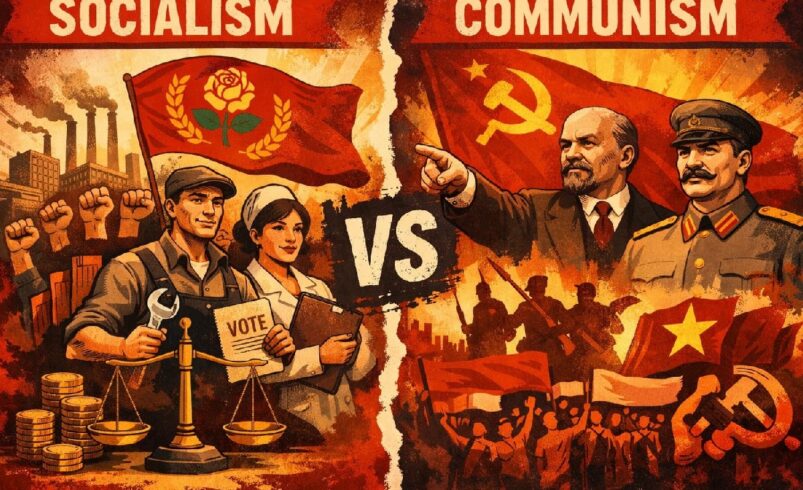
Socialism vs communism are two political and economic ideologies that have shaped global history, influenced revolutions, and sparked debates for centuries. While they are often used interchangeably, they are distinct systems with different goals, structures, and requests. Both philosophies aim to reduce inequality and promote collective welfare, but differ in how they achieve these objectives.
Overview of Socialism vs Communism
Socialism and communism are closely related political and economic ideologies that aim to reduce inequality and promote collective well-being. Both originated from the ideas of Karl Marx, who disparaged entrepreneurship for creating wealth gaps and worker misuse. However, they vary significantly in their construction, goals, and real-world applications.
Socialism is a system in which the government or society controls key industries to ensure a fair distribution of resources, while still allowing some private ownership and market action. It focuses on refining living standards and fulfilling welfare agendas such as healthcare, education, and social security. Many modern republics combine varied forms of socialism and capitalism.
Communism, on the other hand, is a more extreme and theoretical system that seeks to eliminate all private property and social classes. In a true communist society, everything is owned collectively, and wealth is distributed according to need. It also aims for a stateless society, although in practice, collectivist republics have often had robust vital governments.
What is Socialism?
Socialism is an economic and political system in which the means of production, such as factories, land, and wealth, are owned or regulated by the community as a whole, often through the government. The main goal of socialism is to reduce disparity and ensure a fair distribution of prosperity and resources.
In socialist systems, the government may control essential industries such as healthcare, education, and transportation to ensure that basic services are accessible to everyone. However, unlike communism, collectivism does not necessarily eliminate private property or market mechanisms.
What is Communism?
Communism is a political and economic ideology that seeks to establish a classless, stateless society where all property and resources are collectively owned. It is based on the idea that capitalism creates inequality and misuse, and therefore must be substituted with a system that safeguards equal rights.
Under communism, there is no private ownership of property or business. Everything is owned collectively, and goods and services are distributed according to need rather than profit. The final goal is to eliminate social lessons and create a society where everyone pays according to their ability and accepts according to their needs.
Is India Socialist, Capitalist, or Communist?
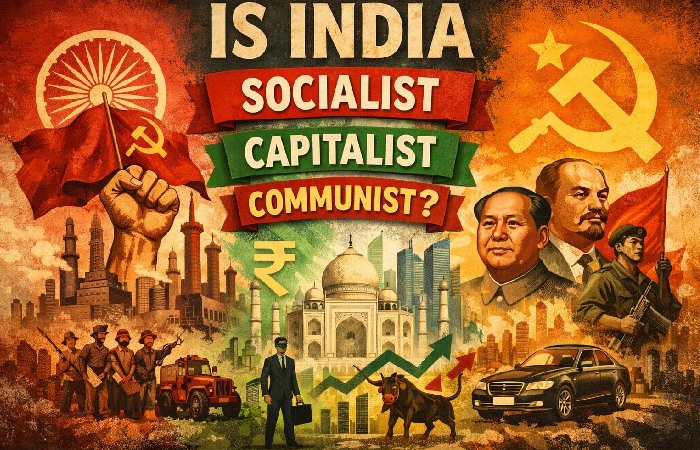
India does not follow a purely socialist, capitalist, or communist system. Instead, it has a mixed economy that combines the basics of both communism and capitalism within a democratic political agenda.
After independence, India leaned more toward socialism with robust government control. However, since the 1991 monetary reforms, it has moved significantly toward a market-oriented (capitalist) system while upholding welfare strategies.
| Feature | Socialist System | Capitalist System | Communist System | India’s Position |
| Ownership | Mostly government-owned | Mostly private-owned | Fully collective | Mixed |
| Private Property | Limited | Fully allowed | Not allowed | Allowed |
| Economic Control | Government-controlled | Market-driven | Fully planned by the state | Mixed |
| Wealth Distribution | More equal | Unequal (market-based) | Fully equal | Moderately equal |
| Political System | Democratic/Authoritarian | Democratic | One-party rule | Democratic |
| Examples | Sweden, Norway | USA, UK | China (historical), USSR | Mixed Economy |
| Government Role | High | Limited | Total control | Balanced |
| Welfare Programs | Strong | Limited | Fully state-provided | Strong |
Why is Socialism Considered so Bad?
Socialism isn’t universally “bad”—that label usually comes from specific censures, historical failures, and ideological disagreements. In practice, some countries have writhed under certain forms of socialism, though others have successfully combined socialist policies. Here are the main reasons critics contend in contradiction to socialism:
1. Reduced Economic Efficiency
Government control can slow decision-making
Lack of competition may reduce productivity
State-run industries sometimes become incompetent
2. Weak Incentives to Work or Innovate
When income differences is minimizes, people may feel less motivated
High taxes can discourage entrepreneurship
Critics argue that innovation thrives more in competitive (capitalist) systems
3. High Tax Burden
Funding welfare programs requires significant taxation
High taxes may reduce disposable income
Businesses may relocate to lower-tax countries
4. Government Overreach
Large government involvement in the economy
Risk of excessive control over businesses and individuals
Can lead to bureaucracy and corruption
5. Historical Failures (in Some Cases)
Countries like the former Soviet Union faced economic stagnation
Shortages of goods due to poor planning
In extreme cases, it has led to authoritarian rule
6. Limited Consumer Choice
Fewer private businesses → fewer options
Standardized products/services instead of variety
Novelty in products may slow down
7. Risk of Dependency
Extensive well-being systems may create reliance on government aid
Critics argue it can decrease self-reliance over time.
Key Differences Between Socialism vs Communism
Although socialism and collectivism share some foundational ideas, they differ significantly in their approach and application. Socialism is often seen as a provisional phase to communism, but in reality, many socialist schemes function independently.
| Aspect | Socialism | Communism |
| Ownership | Public + private ownership | Fully collective ownership |
| Private Property | Allowed (limited) | Not allowed |
| Economic System | Mixed economy (market + government control) | Fully planned economy |
| Wealth Distribution | Based on contribution + need | Based purely on need |
| Class Structure | Decreases inequality | Eliminates all classes (classless society) |
| Government Role | Strong government presence | No government in theory (stateless society) |
| Party-political System | Democratic or semi-democratic | One-party rule in practice (archaeologically) |
| Individual Freedom | More personal and economic freedom | Incomplete individual freedom |
| Transition Stage | Can exist self-sufficiently | Final stage after socialism (as per theory) |
| Real-world Examples | Nordic countries (e.g., Sweden, Norway) | Soviet Union, collective China (historical examples) |
| Goal | Social welfare + reduced inequality | Complete equality + classless society |
| Market Role | Markets may exist | No markets; the state controls all production and delivery |
Examples of Socialism vs Communism
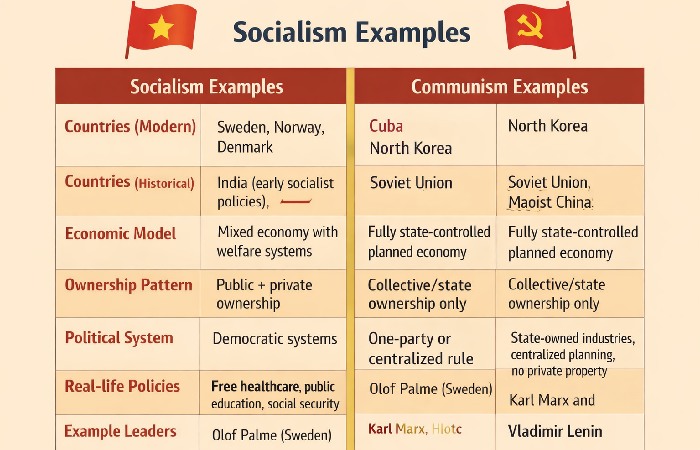
Socialism can seen in countries like Sweden and Norway, where administrations provide strong welfare systems while still allowing private businesses and market frugalities to operate.
Communism include Cuba and North Korea, where the state controls most resources and businesses, and private ownership is largely restricted or absent.
Socialism
Socialism: An economic system where the government or society controls key industries while still allowing some private ownership, seen in countries like Sweden and Norway.
Examples
Sweden – Robust welfare system, free health care, community services with a market cheap
Norway – Government control in key sectors + high social benefits
Denmark – High taxes with strong public services and social safety
India – Mixed with subsidies, public sector, and welfare schemes
United Kingdom – Community healthcare (NHS) and social wellbeing rules.
Communism
Communism: A system where all property is collectively own with no private ownership, aiming for a classless society, historically seen in the Soviet Union and Cuba.
Examples
Cuba – State-controlled economy with free healthcare and education
North Korea – Strict centralized control with no private ownership
China (Maoist era) – Factually followed strict communist rules
Soviet Union – Fully planned economy with state ownership
Vietnam – Communist party-political system with some contemporary market improvements.
In India, the UK, the USA, and London of Socialism vs Communism
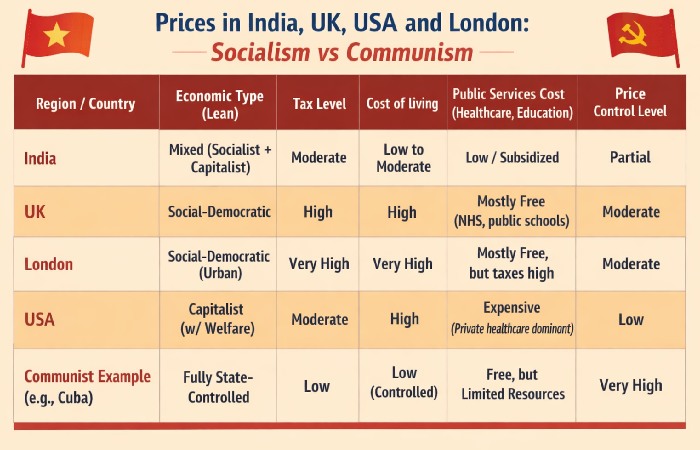
The idea of “prices” doesn’t directly apply to socialism vs collectivism, since they are economic systems, not foodstuffs or services you can buy. However, we can compare the cost of living, taxation, and public spending crossways countries that tend towards socialist or collectivist models, such as India, the United Kingdom, the United States, and London.
| Region / Country | Economic Type (Lean) | Tax Level | Cost of Living | Public Services Cost (Healthcare, Education) | Price Control Level |
| India | Mixed (Socialist + Capitalist) | Moderate | Low to Moderate | Low / Subsidized | Partial |
| United Kingdom | Social-democratic | High | High | Mostly Free (NHS, public schools) | Moderate |
| London | Social-democratic (urban economy) | Very High | Very High | Mostly free, but taxes are high | Moderate |
| United States | Capitalist (with some welfare) | Moderate | High | Expensive (private healthcare dominant) | Low |
| Communist Model Example | Fully state-controlled (e.g., Cuba) | Low taxes (direct) | Low (controlled) | Free but limited resources | Very High |
Similarities Between Socialism vs Communism
Despite their differences, socialism and communism share numerous core values. Both ideologies aim to create a more equal society by addressing the shortcomings of capitalism. They highlight collective wellbeing, social justice, and plummeting economic inequality.
| Aspect | Socialism | Communism |
| Ownership | Public + Private | Fully Collective |
| Economic System | Mixed Economy | Planned Economy |
| Political Structure | Democratic or Mixed | Stateless (theoretical) |
| Wealth Distribution | Based on contribution and need | Based on need only |
| Private Property | Allowed (limited) | Not allowed |
| Class Structure | Reduced inequality | Classless society |
| Government Role | Active role | Eventually no government |
| Real-world Examples | Nordic countries | Soviet Union, Maoist China |
Conclusion
Socialism and communism are closely connect yet fundamentally different ideologies. While both aim to create a more equitable society and address the faults of capitalism, they vary in their approaches, constructions, and goals. Socialism offers a more flexible, applied approach, often blending public control with private enterprise. Collectivism, on the other hand, signifies a more uncompromising vision of a completely equal and classless society.